
First off: a confession. I have read several books since my last blogged book review a few weeks ago, and I plan to get back to reviewing at least some of them on here soon. Many of these are classic children’s books that I have re-read this year with my daughter, but that doesn’t mean I haven’t gotten anything new out of them. In fact, I think that the best children’s books have just as many new things to offer the mind and soul when you’re older as they do when you’re a child.
And on that point, the reason for this break in book reviews is for a different kind of literary post–one that I’m completely book-nerding out about!
John Green Forum at USM
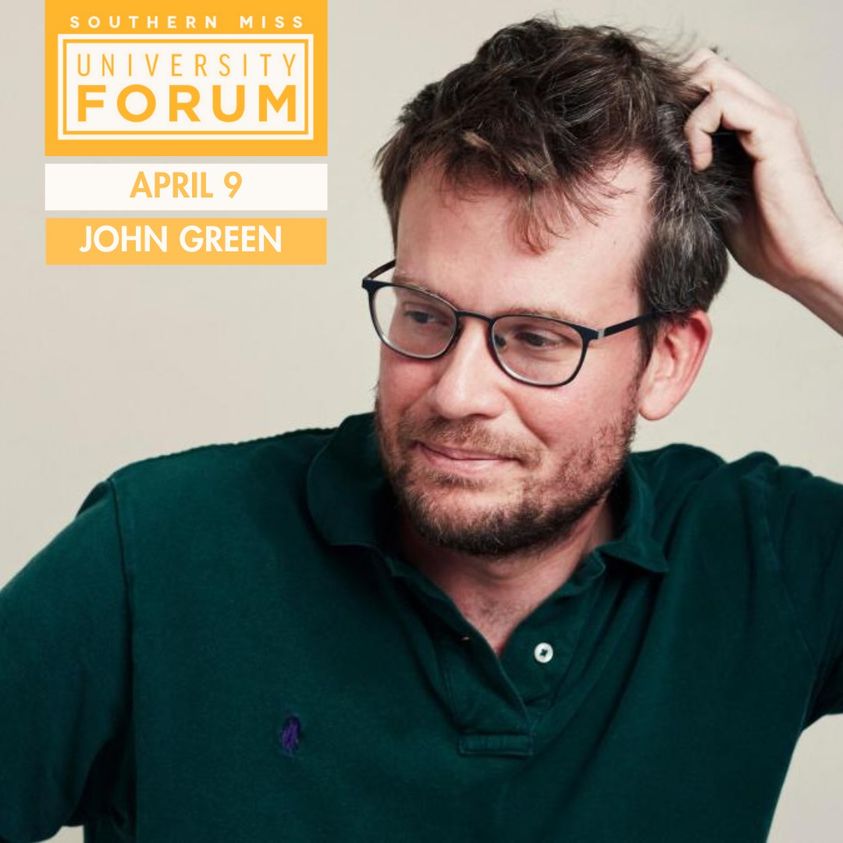
Last night, I got to go sit and listen to a forum hosted by the University of Southern Mississippi and featuring one of my very favorite authors (the author, in fact, of a recent book review published here)—John Green! John Green is best well known for his fiction which is aimed primarily at Young Adults, although his writing goes deeper and expects more of the reader than most Young Adult novels dare. His novels, while full of love and humor, touch on subjects that a lot of people feel uncomfortable discussing: grief and loss, illness, OCD, depression, anxiety and sometimes several of these at once–all under the umbrella of coming of age in this big ole’ confusing world. He’s also well known for his VlogBrothers videos (serving nerds like me since the early days of YouTube) and his more polished, but also entertaining, educational “Crash Course” videos, which engage young learners in subjects from chemistry to history.
During his speech, I got to hear Green describe his writing in his own words. He was a fantastic speaker: funny, witty, and real. He was smart, but also humble. In describing his process of writing, he kept things really simple. He said that writing should always be about “caring for the reader.” In terms of his YA novels, he said his goal is to “write books that care for readers in the unprecedented ‘firsts’ of these confusing years.”
It’s perhaps not an Earth-shattering statement, but it was one that resonated with me strongly as a lifelong reader. The best books, especially those for children/teens/young people, do care for the reader, and they do so in a way that is never lost or forgotten.
I felt the truth of that statement at 22, when I read John Green’s The Fault in Our Stars as a young adult in the process of watching my mom (who was also my best friend) be consumed by cancer. The book was also largely about cancer, loss, and grief–all things my family was experiencing for the first time. It was hard and painful to read, just as what I was going through was hard and painful. I remember that my boss at the time was horrified that I’d be reading something so sad at a time that was already full of sadness. But solidarity and understanding was what I needed then: a friend to bear the reality of that grief and pain and loss. Whenever I think of that book, I think of how it was there for me in that –a place that could handle my pain and discuss my confusion about the world not being the comfortable place I’d always assumed it to be. There are many other books that stick out to me as favorites from childhood and adolescence, too, most less serious than The Fault in Our Stars: Anne of Green Gables. Little Women, A Little Princess. Matilda, Harry Potter. The Once and Future King. As I think about it now- I realize that they all gave me something I desperately needed at the time. They were a piece of the puzzle making up who I would become.
Books that “Care for the Reader” During Our First “Firsts”
I bet if you think about this, you’ll find some similar examples. What are some of your favorite formative works of fiction? What did these books give you, that you really needed then? (Not that all children necessarily need, but what YOU needed?) It’s fascinating to consider this as a reader, and I think it’s necessary to consider if you’re an aspiring writer, too.
I also think once a book has cared for you in this way, at this sort of formative time in your life, it has earned a permanent place within you. There seems to be a transcendent gratitude that forms towards books and authors that shape you as a child and young adult. As Kathleen Kelly said, “When you read a book as a child, in shapes you in a way that no other reading in your whole life does. “
As I consider this, I also picture the packed house of John Green’s forum last night, and the variety of generations in the audience. I am solidly a millennial, the age of Green’s earliest YA readers and YouTube followers during the 2010s. There were also many people there who were younger than I am–college students and high school students with whom his work continues to resonate, 20 years later. I actually was surprised that my younger cousin, a high school student, asked if she could come with me. I didn’t know she was also a fan!
But there were older people in the audience, too–many of them! And this struck me because these are people who wouldn’t have become fans simply because they were young adults reading books made only to care for young adults. This seems to indicate something more than gratitude towards a book that has reached us right when we’re at that age of “firsts.”
The Universality of Firsts
So I thought about it, and here’s my theory. Those “firsts” are universal, and they stick with us longer than the “seconds” and “thirds.” The “firsts” are always and forever part of who we are. I think we carry those people who experienced them around with us always. To receive care through a book geared towards young people, whether it delivers the “medicine” at the time it is directly needed, or many years later when our perspectives have grown, is still very much like meeting a friend who understands and can speak to an intimate version of ourselves that will always remain.
Though we change, mature, and grow, we carry those vulnerable selves with us. I think that, in time, and when growing in the right ways, we hopefully become people who would protect and care for our former selves most fiercely. And, more importantly, who will care for those younger than us who are experiencing those firsts for themselves. But we can still find gratitude in those books that understand where we’ve been and which could have helped us then…that, in new ways, can still help us now.
And now I’m wondering if that’s why I now cry as an adult when starving Sara Crewe gives her bread to the hungrier child in A Little Princess, or when Mrs. Weasley always sends Harry a Christmas sweater too (and he wears it even when Ron throws his own sweater aside). There is something in me that will always be fiercely protective of those resonating archetypes, many of which I now see in own children. And I feel gratitude still for these characters and perspectives, though my own role in the story has shifted.
These are all just thoughts pinging around my brain on a stormy afternoon while my children (unprecedentedly) nap at the same time???!? But honestly: reading a lot of children’s literature lately, and hearing from one of my own favorite YA authors in real life, has definitely gotten me thinking about the power of Children and YA lit. I truly believe it is something special, with a power that can stay with us always.
If you’ve stuck with me this long, thanks! I’d love to know your thoughts on all of this. Leave me a comment to join in the discussion. And keep scrolling to see some pictures and a few epic things John Green said which I managed to jot down.
- Have you read any John Green? If so, what’s your favorite book of his?
- What is a book “cared for you” as a child, teen, or young adult? How did it impact you?
- Do you think we carry around some version of our younger selves and/or the impact of those 1sts? How would you describe your own experience of this?
Now for Pictures, Storytime, and Some Epic John Green quotes!
After getting lost on the not-that-big campus (such is my gift) I finally gave up on any vacant visitor’s parking and grabbed a random parking spot, praying that it would not inconvenience anyone and/or earn me a ticket. We arrived right as the main auditorium was declared full and ended up in this scary-big overflow line (there were even more people behind us). I was crying inside thinking it wasn’t going to work out, but we were able to grab some of the last remaining seats thanks to some determined ushers. Then I almost cried out of gratitude.
It was a real emotional rollercoaster before any genius words were spoken, I tell you. I wore my bright red rash, as always, when under any amount of duress.

The hall could not have been more packed! I ended up sitting between two friendly strangers in the highest section of the balcony, but the view of the stage was still pretty clear. Right before putting my phone away per forum protocol, I grabbed a one-and-only photo of the man himself. (I think it’s non-professionalism vouches for it’s authenticity.) I also packed a tiny notebook, which I intended to use to jot some notes. However, I was so wrapped up in listening that I didn’t get many notes (no regrets), but I do want to share the few quotes I wrote down, following this stunningly professional picture.
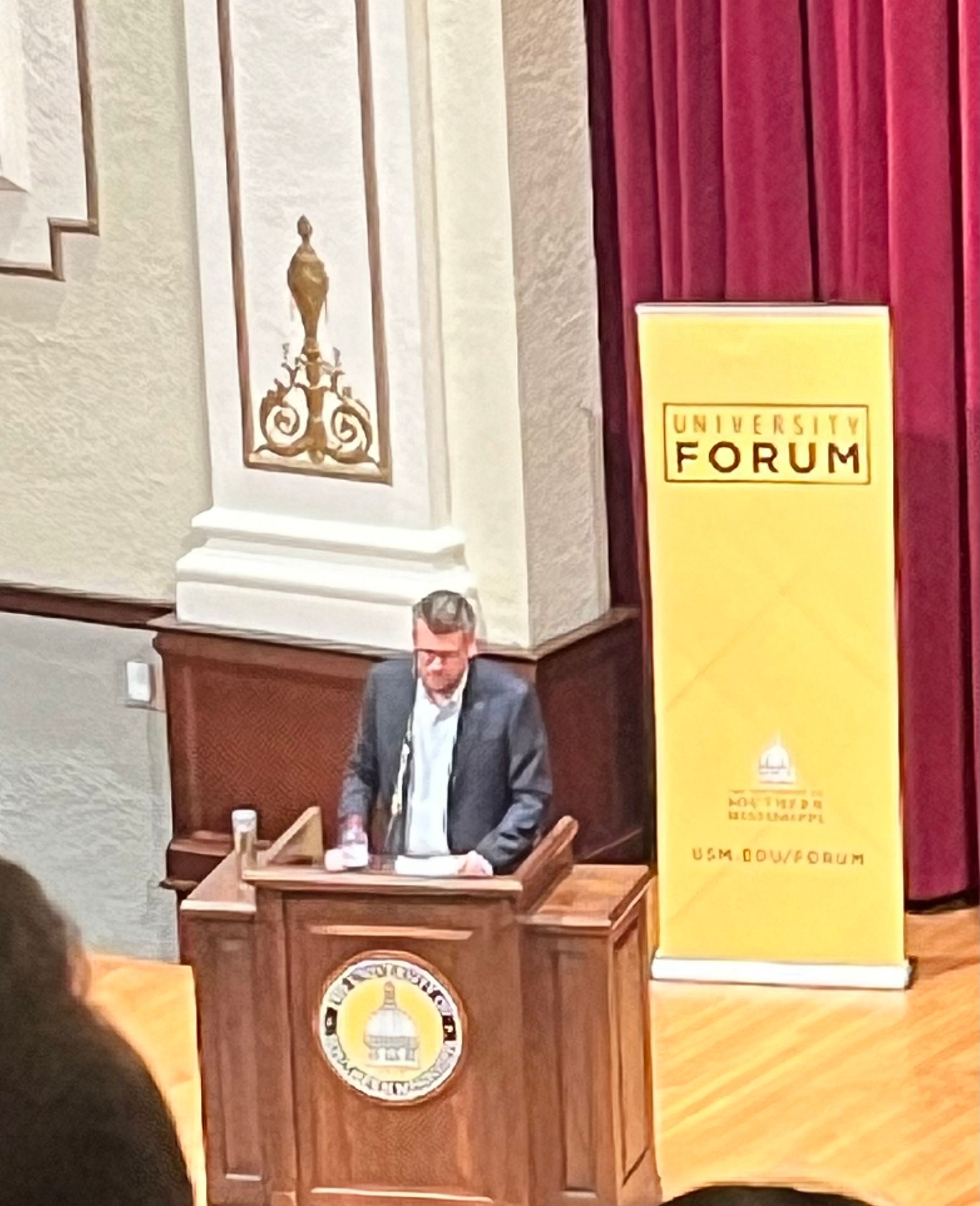
In addition to discussing his writing, John Green had some truly impactful things to say about despair vs. hope. He talked about how his own experiences serving as a chaplain in a children’s hospital impacted him deeply and caused him to despair, and how the process of writing was therapeutic. He described that -even though he’s rarely written about those experiences directly- all of his books are really about that singular experience in some way or other.
“I wrote myself out of despair.”
He also encouraged anyone going through something difficult right now, or struggling to remember this key piece of advice:
“Things as they are, are not things as they will be. Keep going.”
He talked about hope as both the product of human determination and the enemy of despair, saying.
“As a worldview, despair has a weakness. It doesn’t tell the truth.”
(And)
“Sometimes it is easier to notice the bad than to notice the good. Good news happens slowly, as the result of human effort. Bad news happens all at once.”
He gave some really encouraging examples of recent good that has been accomplished based on years of human effort, but that we might not always notice in the face of immediate dark news. He also pointed out how this hope should inspire us to combat the despair, to keep going and creating good.
The whole experience of the forum is very much on my mind today! I feel inspired as a reader, writer, human– all the things. Thanks John Green for giving this lecture/Q & A and thanks to USM for inviting him!
Lastly, some #nerdfighter inspired photos because #DFTBA. If you know, you know. If you don’t know, here’s a YouTube channel.

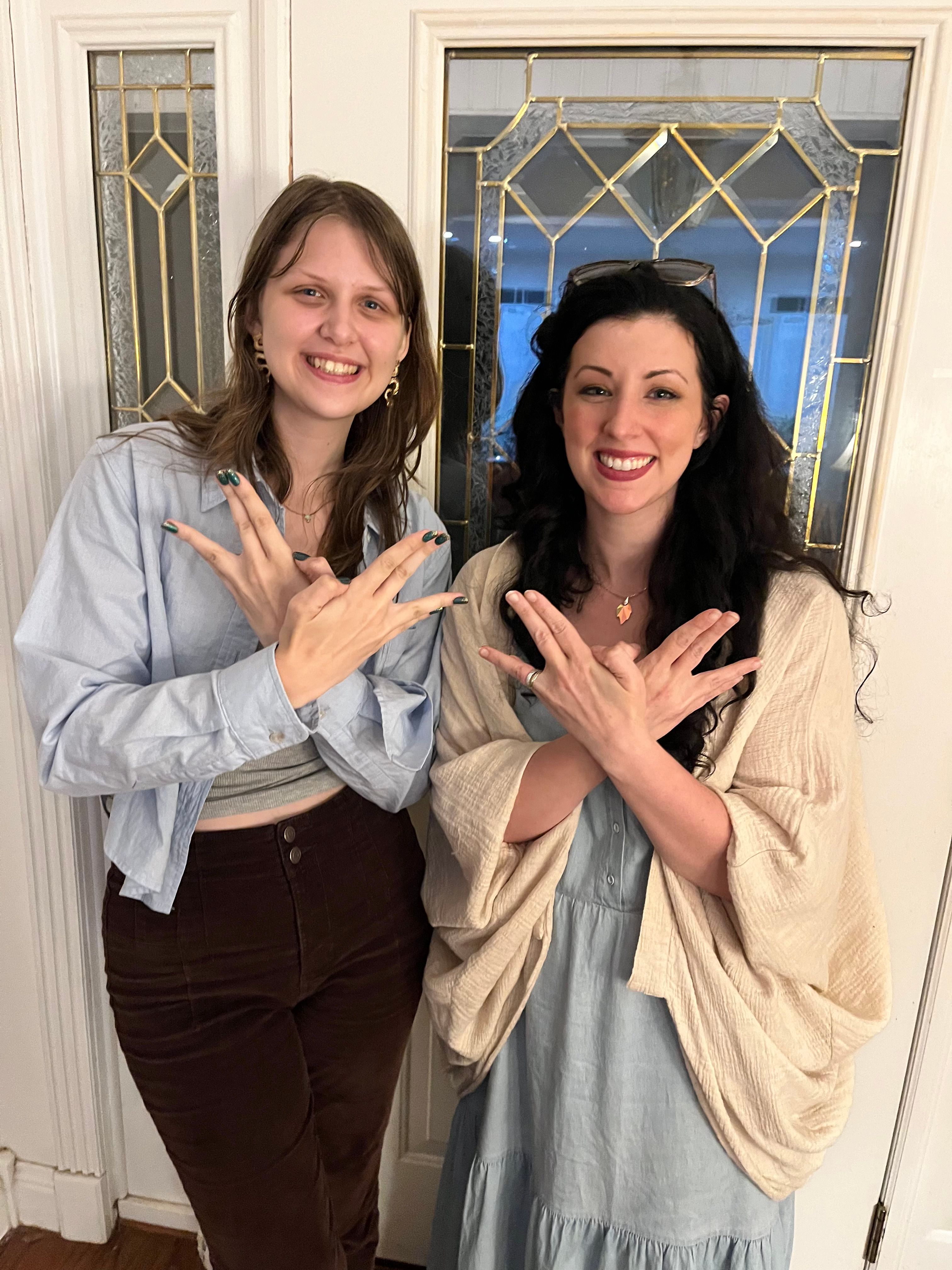
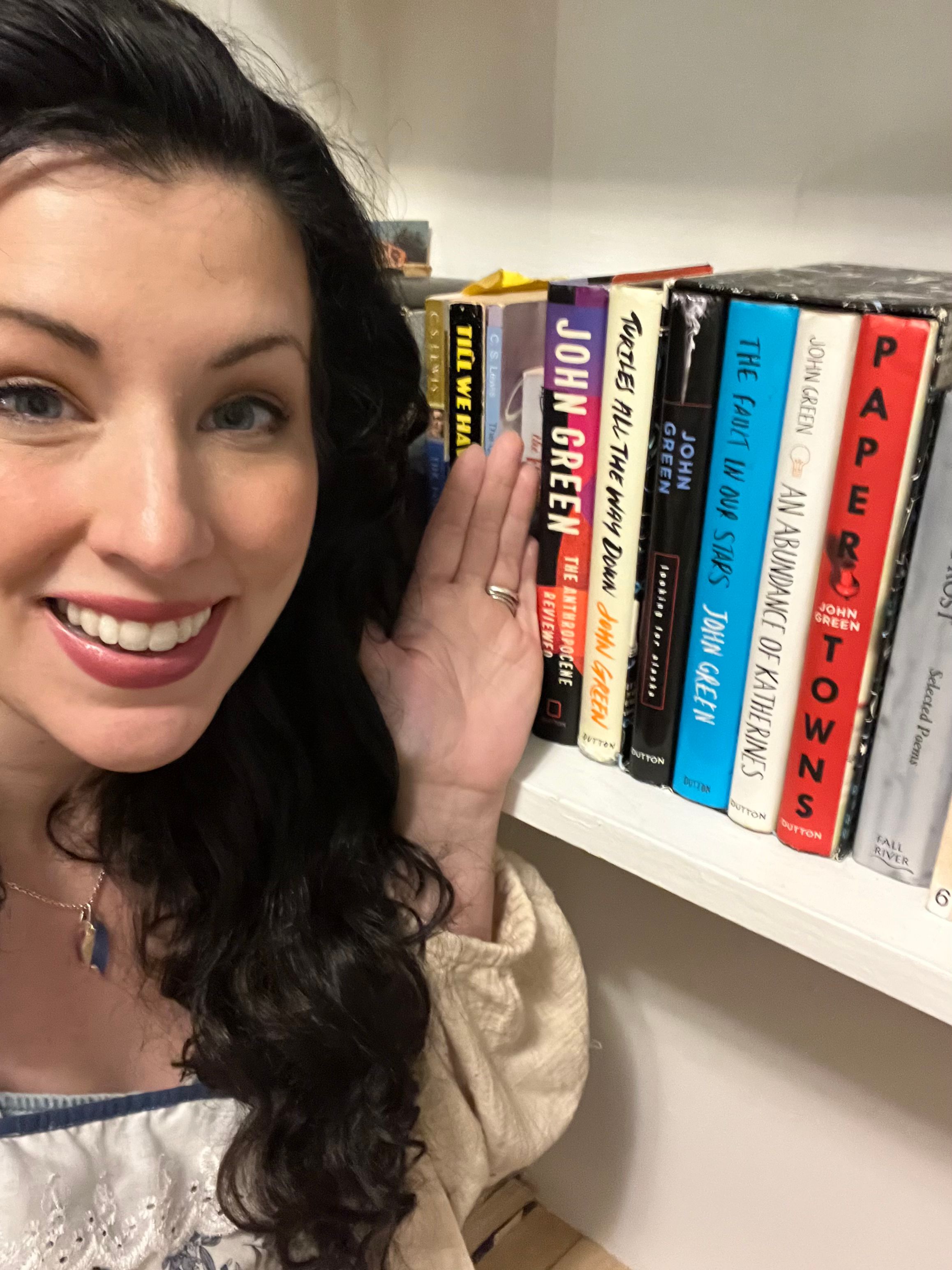
(Last one is me getting pumped to re-read everything he’s written.)



 Write Where You Are | Books, Life, Food, a Little Bit of Everything